


In trusted partnership with the KnowledgeFlow Cybersafety Foundation

Every day, educators are encountering artificial intelligence in the tools they use and the work their students produce; sometimes intentionally, and sometimes without realizing it. From automated feedback to adaptive learning platforms, AI is already shaping how learning happens. Yet, like design, AI is not neutral. The way it is built, trained, and used can support learning, introduce bias, raise privacy concerns, or widen existing inequities.
Module 5: The AI Toolkit invites educators to build a clear, grounded understanding of what AI is (and what it is not) within an educational context. This module explores how AI systems work, where they appear in classrooms, and the ethical considerations that come with their use. You will examine issues such as data privacy, bias, equity, and environmental impact, while also exploring how AI can support assessment, feedback, and personalized learning when used responsibly. Through practical examples, reflection opportunities, and ethical frameworks, this module equips educators to make informed decisions about AI and to guide students thoughtfully in an AI-influenced learning environment.
Scroll down to continue your PDday journey!
Contents
Part 1
AI Foundations
Artificial intelligence is increasingly present in the tools educators and students use every day, yet its meaning and impact are often misunderstood. In this submodule, you will explore what artificial intelligence is, how it functions, and how it appears in educational settings. You will learn the difference between analytical and generative AI, examine the core techniques that power AI systems, and trace key moments in the development of AI over time. This submodule also addresses common misconceptions about AI and highlights the limits, risks, and responsibilities that come with its use in classrooms.
Note: Click the video to play it or click the “Watch on YouTube” button on the bottom left of the video to view it directly in YouTube.
Test Your Knowledge!
Reflecting Back
When considering how AI might fit into your teaching practice, it can be helpful to move beyond what the technology can do and reflect on how it could support student understanding. Generative and analytical AI tools can influence how lessons are explained, how feedback is provided, and how learning gaps are identified. Thinking about a recent lesson where students struggled with comprehension or engagement may help you identify opportunities where AI could offer additional explanations, practice, or insight. By reflecting on where AI could clarify complex ideas, support pacing, or respond to individual needs, you can begin to see how small, intentional uses of AI might improve lesson comprehension while keeping your professional judgment and instructional goals at the centre of learning.
Part 2
AI Impacts & Classroom Relevance
As artificial intelligence becomes more embedded in the tools students and teachers use each day, understanding its influence on learning is no longer optional. In this submodule, you will examine why AI awareness is essential in educational settings and how AI can both support and challenge classroom practice. You will explore the positive and negative effects of AI, learn how concepts like the Turing Test explain why AI responses can sound convincing without being accurate, and consider the ethical, social, and privacy implications of AI use in schools. This submodule also highlights the importance of clear communication with parents, alignment with school board policies, and thoughtful reflection before introducing AI tools.
Note: Click the video to play it or click the “Watch on YouTube” button on the bottom left of the video to view it directly in YouTube.
Test Your Knowledge!
Reflecting Back
Teaching responsible AI use begins with helping students understand that AI is a tool that supports learning, not a substitute for thinking or effort. Reflecting on your current classroom practices can help you identify where expectations around appropriate use, transparency, and verification could be made clearer. Consider how you already model responsible technology use through citation, source checking, and discussion of accuracy and bias. By intentionally embedding conversations about when AI is helpful, when it should be questioned, and how to acknowledge its use, you can support students in developing ethical habits that carry across subjects and digital environments.
Part 3
AI in Action
As artificial intelligence moves from theory into everyday classroom practice, teachers need a clear understanding of how these tools are actually being used in schools. In this submodule, you will explore practical examples of AI in classrooms, from assessment and feedback to adaptive learning systems and assistive technologies. You will examine how AI supports personalization, engagement, and efficiency, while also considering the limits, risks, and design choices that shape student experiences. This submodule also highlights the skills students can develop through responsible AI use and reflects on how AI is influencing the teacher’s role.
Note: Click the video to play it or click the “Watch on YouTube” button on the bottom left of the video to view it directly in YouTube.
Test Your Knowledge!
Reflecting Back
AI tools can support critical thinking and creativity when they are used as prompts for exploration rather than sources of final answers. Reflecting on recent learning activities may help you identify opportunities where AI could encourage students to compare ideas, evaluate multiple perspectives, or revise their thinking. For example, AI-generated examples, drafts, or suggestions can become material for analysis, critique, or improvement. When students are asked to question, adapt, or build upon AI outputs, they practice deeper thinking and creative decision-making while maintaining ownership of their work.
Part 4
AI & Ethics
As artificial intelligence becomes more embedded in educational tools and systems, it raises important ethical questions that go beyond how the technology works. This submodule focuses on the ethical responsibilities that come with using AI in classrooms, including privacy, bias, equity, transparency, and accountability. You will examine how AI tools collect and use data, how misuse and harm can occur, and why informed consent and security matter in educational contexts. Through ethical frameworks, real-world risks, and practical evaluation tools, this submodule supports teachers in making thoughtful, professional decisions about AI use. The goal is not to discourage innovation, but to ensure that AI is used in ways that protect students, support learning, and uphold trust in educational environments.
Note: Click the video to play it or click the “Watch on YouTube” button on the bottom left of the video to view it directly in YouTube.
Test Your Knowledge!
Reflecting Back
Using AI ethically requires ongoing reflection on how tools align with your professional responsibilities. Taking time to consider recent or potential AI use can help you evaluate whether your judgment remains central to instructional decisions, whether student data and well-being are adequately protected, and whether students and families are clearly informed about AI use. Reflecting on these three responsibilities can reveal areas where additional clarification, safeguards, or communication may be needed. This process supports thoughtful, transparent AI use that prioritizes trust, safety, and educational purpose over convenience or novelty.
To complete this module and receive your credit, please complete the following quiz and receive a grade of at least 70% to pass.
PDday.ca Module 5 Quiz
Lesson Plans
PDday.ca Lesson Plans for your classroom
Explore our full collection of digital media literacy and cybersafety lesson plans designed specifically for K–12 classrooms, fitting effortlessly into your existing schedule and curriculum. Each lesson is engaging, easy to deliver, and intentionally designed to be completed in 45 minutes or less; making classroom integration simple and stress-free.
PDday.ca Teaching Materials
Here are three slide shows, filtered by grade range (Grades 9–12, 5–8, and 1–4), that you can add straight into Google Classroom. These slideshows make it easy for you to turn the information into teachable lessons with ready-to-go slides so that students can become the experts themselves. You can present them in class or share them with students and parents to explore on their own.
PDday.ca Class Activities
Here are lesson activities you can use directly in the classroom and upload to Google Classroom. There is a teacher version and a student version that can be directly handed out. This version works as a teacher guide or can be shared with students for easy use. The activities are curriculum-aligned and designed to deepen students’ understanding of cybersafety concepts. They are organized by grade range (Grades K-4 and Grades 5-12) and conveniently included in a single document for easy access.
Curriculum Alignment for Teachers
We have streamlined the integration of our cyber safety materials into your curriculum with a comprehensive guide. This guide helps educators align our resources with provincial standards, making it easy to incorporate our content into lesson plans while meeting educational outcomes. By filtering by province, grade, and course, educators can find the exact resource or lesson plan needed to include cybersafety education.
Tip Sheets & Guidebooks
About AI Tip Sheets
AI Timeline
AI Terms
Positive & Negative Effects of AI
Using AI Tip sheets
Practical Guide to Generative AI
How to use Generative AI safely
ChatGPT For Educators
AI Tool Evaluation Checklist
AI-generated Intimate Images tip sheets
A notice to teachers and principles
How to best support a victim
Info for teens
AI Ethics Tip sheets
Privacy/Security Practices & Measures
Additional Courses
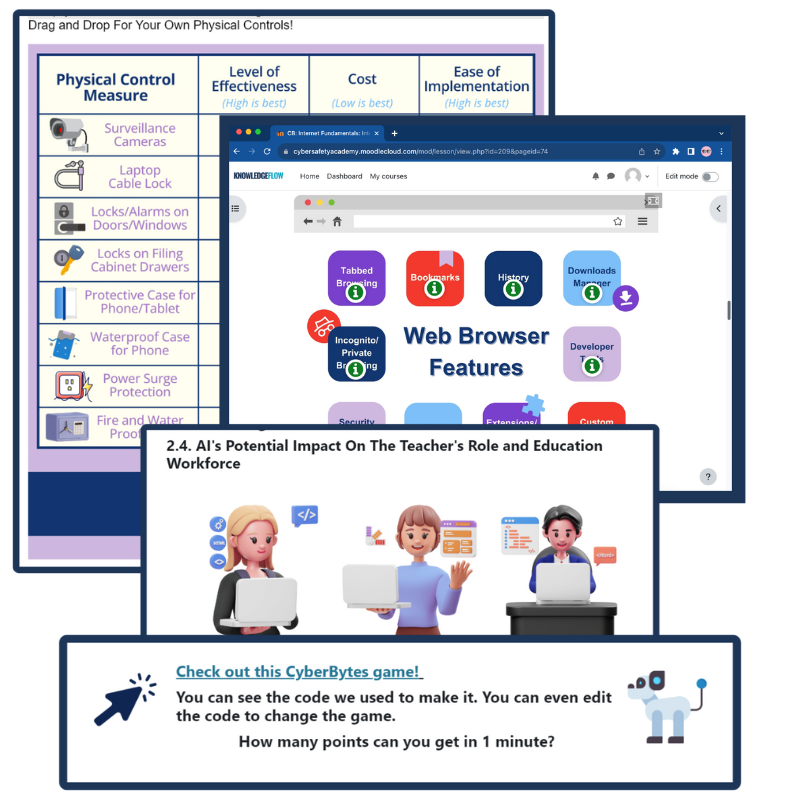
CyberBytes: Empowering Educators Through Digital Literacy
The CyberBytes Program is a free, self-paced course created exclusively for K-12 educators in Canada, designed to fit your schedule and enhance both your personal and professional growth. Developed by certified cybersecurity experts, this program empowers you to create engaging, tech-savvy classrooms while equipping you and your students with the skills needed to thrive in an ever-evolving digital landscape.
If you would like to…
- Further expand your knowledge on AI in education, AI-driven assessment and feedback tools, AI-powered adaptive learning systems, possible impacts of AI on the teacher’s role and education workforce;
- Obtain cross-curriculum ready-to-use lesson plans, classroom posters and checklists, student resources, tip sheets, and other external resources;
Please go to ICTC’s online CyberBytes course and complete the Cyber Design & Evolution Gigabyte module by clicking the button to the left.
Teacher Toolkit

#UnHackable classrooms, teachers, principals, and administration lead to #UnHackable schools. This weekly, 12-week email course will be sent directly to your email address, covering the foundations of cybersafety you and your classroom need to know. These toolkits were created to include easy-to-digest content you can seamlessly add to your classroom activities and personal life. Ready-to-use lesson plans are included in each edition!

The Information and Communications Technology Council (ICTC) is a neutral, not-for-profit national centre of expertise with the mission of strengthening Canada’s digital advantage in the global economy. For over 30 years, and with a team over 100 experts, they have delivered forward-looking research, practical policy advice, and capacity-building solutions for individuals and businesses. ICTC’s goal is to ensure that technology is utilized to drive economic growth and innovation and that Canada’s workforce remains competitive on a global scale. ICTC’s PDday is funded by the Government of Canada’s CanCode Initiative.
 English
  French
  Chinese
  Spanish
  Ukrainian